Logo

Logo
3 Countryside Plaza, Countryside IL 60525 (708) 588-1024 (630) MARRY-ME

Search This Blog

Showing posts with label crown jewels. Show all posts

Wednesday, October 13, 2010

Opals Play of Color


Opals

The name means to see a change of color; opals have an unusual optical effect of shifting spectral hues described as play of color. The birthstone for October, opal is revered as a symbol of hope, fidelity and purity and reveals the colorful attributes of those who wear it.

Opals are a chameleon of stones, encompassing the essence of every gemstone in one and date back to prehistoric times.

Opals are described according to their transparency and body color. While experts divide gem opals into many different categories, the main types (according to the American Gem Trade Association) are:

  • White opal – translucent to semi-translucent with play-of-color against a white or light gray body color.
  • Black opal – translucent to opaque with play-of-color against a black or other dark body color.
  • Fire Opal – transparent to translucent with brown, yellow, orange, or red body color. This material, which often does not show play-of-color, is also known as “Mexican opal,” “gold opal,” or “sun opal.”

Play-of-color occurs because opal is made up of sub-microscopic spheres stacked in a grid-like pattern, like layers of ping-pong balls in a box. This structure breaks up light into spectral colors. The colors you see depend on the sizes of the spheres. Opal is a non-crystallized silica, which is a mineral found near the earth’s surface in areas where ancient geothermal hot springs once existed. As the hot springs dried up, layers of the silica, combined with water, were deposited into the cracks and cavities of the bedrock, forming Opal.

The Opal Peacock Brooch was designed by Harry Winston, Inc., and features a 32-carat black opal from Lightning Ridge, Australia. The opal is accented with sapphires, rubies, emeralds, and diamonds set in yellow gold. The Opal Peacock was donated to the National Gem Collection by Harry Winston in 1977.

Opal Peacock Brooch on display at the Smithsonian

Because opal contains varying amounts of water, it is a soft stone and if exposed to changes in heat and pressure, the appearance can change. When water evaporates out of an opal, the stone can appear to be slightly smaller and the stress

Opal is a soft stone, easily altered in appearance by changes in heat and pressure. This mineral contains varying amounts of water within it that determine the appearance of the gemstone. When water evaporates out of an opal, the stone appears slightly smaller and the stress of the evaporation creates cracks on it.

Folklore:

Prized for its unique ability to refract and reflect specific wavelengths of light, the Opal was also called “Cupid Paederos” by the Romans, meaning a child beautiful as love.

Arabic legends say it falls from the heavens in flashes of lightning. The ancient Greeks believed opals gave their owners the gift of prophecy and guarded them from disease. Europeans have long considered the gem a symbol of hope, purity, and truth.

Some people think it’s unlucky for anyone born in another month to wear an opal, but that particular superstition comes from a novel written in the 1800s (Anne of Geierstein by Sir Walter Scott) and not from ancient belief or experience. In fact, throughout most of history, opal has been regarded as the luckiest and most magical of all gems because it can show all colors. Once, it was thought to have the power to preserve the life and color of blond hair.

Wednesday, September 22, 2010

Sapphires, taste the rainbow

While the name sapphire comes from the Latin word for blue, sapphirus, this precious stone comes in a whole spectrum of colors including violet, indigo, blue, green, yellow, orange, pink and even gray, brown, black and colorless. Red variations of the sapphire mineral (corundum) is exclusively ruby. Next to diamond, Sapphire is the second hardest known natural substance (next to diamond), with a hardness of 9 on the mohs scale, it is ideal for all types of jewelry, especially rings.

Formed billions of years ago, deep below the earth’s crust and in the mantle, conditions of high temperature and pressure formed corundum, the sapphire mineral (rubies are red corundum). Sapphires are a very desirable gem due to its color, hardness, durability and its luster. The most valuable color of sapphire is known as Kashmir sapphire and is a cornflower blue. Corundum with asterism (inclusions of tiny, slender, parallel Rutile needles) in the stone are called star sapphires because of the six (sometimes 12) point star that appears on the stone.

Sapphires come from Thailand, Sri Lanka, Madagascar, Tanzania and Australia; other sources include Montana, Cambodia, Nigeria, Kenya and China. The most famous sources for sapphires however are the Kashmir region of India and Burma (Myanmar).

There have been many famous sapphires in history including on the crown jewels of England and most famously, the Star of India which is 536 carats. About three hundred years ago in Sri Lanka, the star sapphire (which is almost flawless and had stars on both sides) was discovered and later donated to the American Museum of Natural History by JP Morgan where it was later stolen.

The story of its theft adds intrigue to the stone’s fame. Thieves discovered that the valuable gems in the Museum of Natural History were very poorly guarded, and they unlocked a bathroom window during the museum hours. When they returned after the institution was closed for the night, sure enough, the window was still open, and they climbed right in. The Star of India was the only gem that had an alarm, and as luck would have it, the battery on the alarm was dead. The thieves made off with the gems and were later recovered in a locker in a bus station Miami.

Folklore about Sapphires

The ancient Persians believed that the Earth was imbedded into a gigantic blue Sapphire stone. For the Buddhists, a Sapphire represented friendship and loyalty. For others, Sapphire is the stone of prosperity, preventing terror and poverty in men. During the 18th century, Sapphire was used to test female loyalty, changing its color if its wearer was unfaithful.

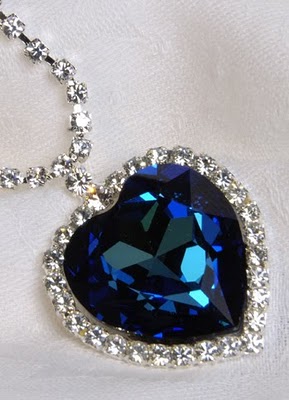
The movie the Titanic featured a fictional sapphire necklace which was based on the famous Hope Diamond. Princess Diana’s engagement ring had a sapphire center stone and Queen Elizabeth has a sapphire engagement ring as well. Other celebrities wearing sapphires include: Joan Crawford, Penelope Cruz, Debra Messing, and Jean Harlow.

Titanic... Heart of the Ocean

Heart of the Ocean

Cleaning a sapphire: use soapy water or commercial solvent and a brush.